

As the impacts of climate change increasingly threaten global public health, the need for effective early warning systems becomes more urgent. The distribution of climate-sensitive infectious diseases is changing as a result of climate change and this presents emerging threats for Europe. In response to this growing challenge, the EpiOutlook platform is being developed within the IDAlert project as a forecasting tool for infectious disease risk management
IDAlert is part of the Climate-Health Cluster, a collaboration funded by the EU Horizon Europe programme, aimed at improving the societal and policy impact of research linking climate and health. The EpiOutlook platform will provide a cutting-edge tool for assessing and forecasting climate-sensitive infectious diseases (CSIDs) in Europe. By integrating seasonal climate predictions with disease risk indicators, EpiOutlook will offer decision-makers an interactive and informative outlook on public health risks.
Why EpiOutlook?
Climate change has significant implications for human health, with many infectious diseases being highly sensitive to shifts in temperature, precipitation patterns, and extreme weather events. As regions experience more extreme weather events and increasingly suitable climatic conditions, the risk of outbreaks of diseases like dengue, malaria, tick-borne diseases, and water-borne infections increases. However, these risks are often difficult to predict due to the complex interactions between climate variables, underlying socio-economic inequalities and disease transmission patterns.
EpiOutlook seeks to address this gap by providing an informative and interactive platform that increases the capacity of decision-makers to prepare for and mitigate these risks. The platform will use advanced subseasonal-to-seasonal (S2S) climate forecasts to predict changes in the climatic suitability of relevant disease vectors up to six months in advance, enabling timely and targeted interventions before public health emergencies arise.
How does it work?
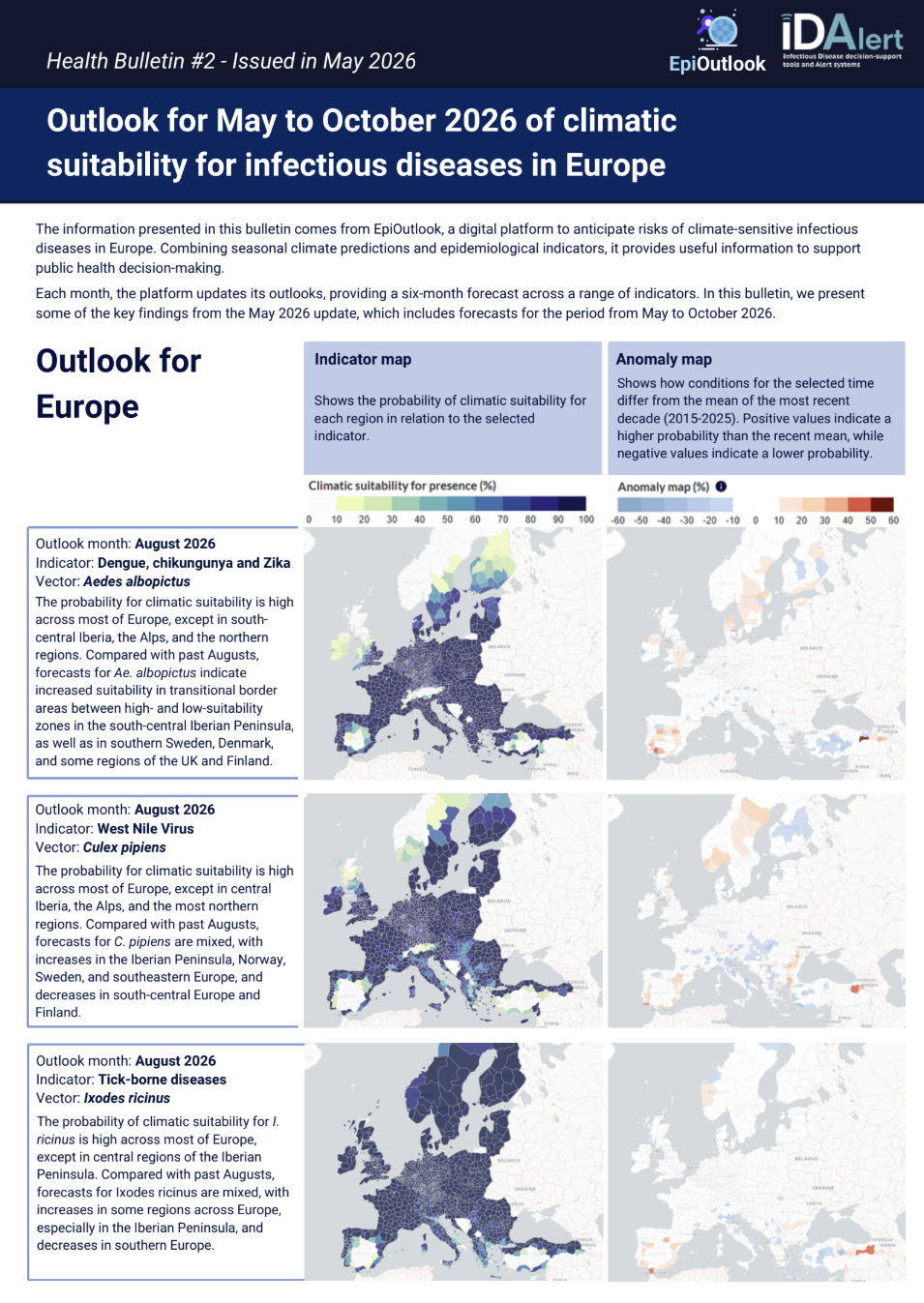
EpiOutlook currently combines seasonal climate predictions (1-6 months in advance) with threshold-based climatic suitability models for relevant disease vectors. Currently, the platform hosts the following indicators:
- Drought
- Malaria
- Tick-borne diseases
- West Nile virus
- Dengue, chikungunya, and Zika
The platform’s predictive power relies on ensemble climate predictions made on seasonal timescales, which are then processed to provide informative and actionable forecasts for public health officials and other key stakeholders.


Target users and stakeholders
EpiOutlook is designed in collaboration with a wide range of users, including public health authorities, humanitarian agencies, medical and veterinary practitioners, the travel and tourism sector and the general public. Each of these groups face unique challenges in managing the risks posed by CSIDs, and EpiOutlook aims to provide tailored insights to help mitigate those risks.
The platform offers a user-friendly interface that simplifies complex data, making it accessible to non-experts while ensuring the necessary level of detail for technical users. Through interactive visualizations and detailed summaries, EpiOutlook helps users identify high-risk areas, understand the underlying climate drivers, and make informed decisions about public health interventions.
The future of EpiOutlook
Once fully developed, EpiOutlook will be accessible via the European Climate and Health Observatory (ECHO), ensuring its integration into the broader network of climate-health initiatives. This approach not only ensures the platform’s relevance and user-friendliness but also guarantees its long-term sustainability, as EpiOutlook will be maintained and updated beyond the IDAlert lifespan.
EpiOutlook is just the beginning of a broader effort to bridge the gap between climate science and public health. The platform is designed to be scalable and adaptable, with future plans to expand its coverage to additional regions and climate-sensitive diseases. Looking ahead, the platform holds great potential for supporting the development of climate-resilient health systems across Europe and globally.
Professor Rachel Lowe from the Barcelona Supercomputing Center, co-coordinator of IDAlert, said “As climate change continues to impact the emergence and spread of infectious diseases worldwide, innovative tools like EpiOutlook will play a critical role in public health preparedness. By providing early warning indicators and climate-informed insights, the platform equips stakeholders with the knowledge they need to prevent outbreaks, mitigate risks, and protect public health”.